

























Two individuals are accused of taking 3,600 birds, including golden and bald eagles

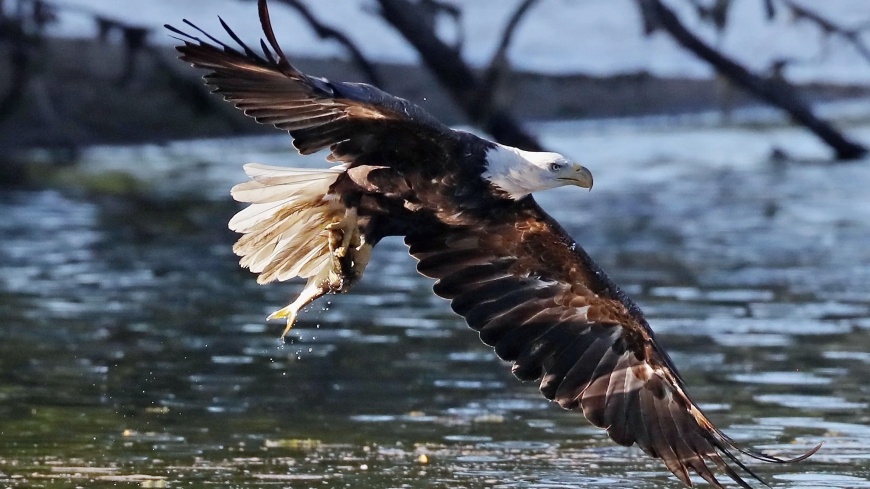
Two individuals engaged in a "killing spree" in Montana, including on the Flathead Indian Reservation, where approximately 3,600 birds, including bald and golden eagles, were unlawfully hunted and killed. The suspects then participated in the illegal black market trade of eagle parts, a persistent issue for U.S. wildlife officials, as outlined in a federal grand jury indictment.


According to the indictment, the accused individuals collaborated with others to carry out the bird killings, employing tactics such as using a deceased deer to attract and shoot eagles. The defendants, Simon Paul of St. Ignatius, Montana, and Travis John Branson of Cusick, Washington, along with unnamed co-conspirators, sold eagle feathers, tails, wings, and other parts for substantial amounts of cash across the United States and elsewhere.
The indictment details text messages obtained by investigators, indicating that Branson and associates communicated their involvement in a "killing spree" to gather more eagle tail feathers for future sales. Paul is described as a "shooter" for Branson in the document.
The illegal activities spanned from January 2015 to 2021 near Ronan, Montana, within the Flathead Reservation, home to the Confederated Salish and Kootenai Tribes. Although the indictment does not specify the number of eagles among the 3,600 birds killed, illegal shootings are a significant contributor to golden eagle fatalities, according to recent government studies.
Rich Janssen, director of the tribe's Natural Resources Department, emphasized the cultural importance of eagle feathers to tribal members for traditional dress and honor ceremonies. Tribal law enforcement participated in the investigation, with Janssen expressing hope that the charges serve as a warning to others, emphasizing their vigilance in such cases. Bald eagles, a symbol of the United States, and golden eagles are culturally significant to American Indians. U.S. law strictly prohibits the killing, wounding, or disturbance of eagles without a permit, extending to the taking of any parts, nests, or eggs, making the possession of feathers found in the wild potentially illegal.
Federally recognized tribes have the option to seek permits from the U.S. Fish and Wildlife Service for religious purposes, while enrolled tribal members can apply for eagle feathers and other parts through the National Eagle Repository. However, a considerable backlog of requests exists, contributing to a prolonged waiting period, according to Rich Janssen and independent eagle researchers.
The substantial demand for eagle parts, particularly feathers from young golden eagles, has led to a thriving black market. Bryan Bedrosian, a researcher with the Teton Raptor Center in Wilson, Wyoming, noted waits of up to five years for these feathers from the repository, contributing to the illegal trade.
Rob Domenech, executive director of Raptor View Research Institute in Missoula, Montana, emphasized that addressing the delays in processing requests could potentially curb the illicit trade in eagle parts. He said that there are some of the biggest populations of eagles and other large raptors in the U.S. West in the region where the birds were reportedly being shot. This includes raptors such as eagles and hawks, as well as other birds that travel northward to spend the winter in the Flathead region. At certain periods of the year, it's essentially a raptor bonanza, so this kind of behavior is appropriate, according to Domenech.
Concerns about the backlog of tribal permit requests were not immediately addressed by representatives of the U.S. Fish and Wildlife Service. Beyond what is stated in the indictment, a representative for the office of Montana U.S. Attorney Jesse Laslovich, who is leading the prosecution, declined to comment.