





















After the horrific Japan Airlines accident, passengers express relief and fear:
In a harrowing incident at Tokyo's Haneda airport, Japanese Airlines flight 516 turned into a scene of terror when it erupted into a fireball

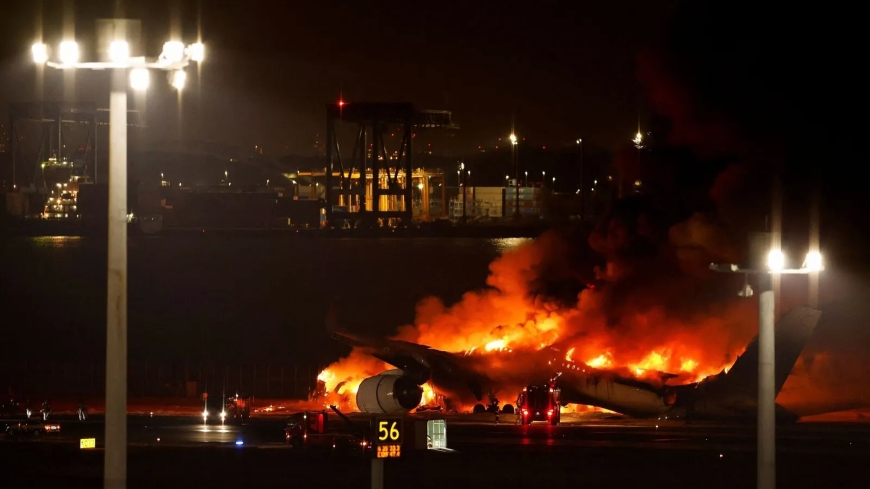
In a harrowing incident at Tokyo's Haneda airport, Japanese Airlines flight 516 turned into a scene of terror when it erupted into a fireball after colliding with an earthquake relief aircraft on the runway. The tragic collision claimed the lives of five people, with the crew racing against time to evacuate 379 passengers, including eight infants before the flames engulfed the Airbus A350 passenger plane.


As thick smoke rapidly filled the cabin, flight attendants took charge, using megaphones to calm and guide anxious passengers to safety through three emergency exits on slides. The successful evacuation, described as miraculous by some survivors, defied expectations and surprised aviation experts.
"I heard an explosion about 10 minutes after everyone and I got off the plane," said 28-year-old passenger Tsubasa Sawada. "I can only say it was a miracle; we could have died if we were late."
While Japan Airlines reported that four passengers were taken to the hospital, the most severe injury was reported as "bruising." Tragically, five out of the six crew members lost their lives on the second aircraft, a De Havilland Canada DHC-8, with the captain reportedly in critical condition, according to Japan's transport minister, Tetsuo Saito.
Japan Airlines is actively participating in the ongoing investigation to determine responsibility for the deadly crash, as stated by the senior vice president of corporate safety and security, Tadayuki Tsutsumi.
Summary: A horrifying collision between Japanese Airlines flight 516 and an earthquake relief aircraft at Tokyo's Haneda airport resulted in a fireball, claiming five lives. The Airbus A350 passenger plane successfully evacuated all 379 people, including eight infants, in a miraculous feat that surprised experts. Flight attendants played a crucial role in calming and guiding passengers amidst thick smoke. The airline is now actively engaged in the investigation to determine responsibility for the tragic incident.
Japan Airlines reports that its crew had received clearance to land from air traffic control before the collision with an earthquake relief aircraft at Tokyo's Haneda airport. Audio recordings from LiveATC.net seemingly confirm the crew's acknowledgment of the clearance for runway 34, stating, "cleared to land 34 right."
Passengers and witnesses recounted moments of terror turning into relief as it became evident that everyone onboard the Airbus A350 had survived. Tsubasa Sawada, a passenger, expressed his initial fear, stating, "I thought I was going to die." Runway incursions like this are deemed rare but potentially catastrophic, according to Graham Braithwaite, a professor at the UK's Cranfield University specializing in safety and accident investigation.
Guy Maestre, a passenger on an adjacent plane, described hearing a "big bang" and witnessing a trail of flames down the runway. Despite the fiery crash scenes, Satoshi Yamake, another passenger, highlighted the calm atmosphere inside the plane after landing, noting that people were not panicking.
Yamake detailed the incident, stating that although the landing seemed normal, he noticed a fire shortly before an evacuation announcement. Despite the unfolding chaos, he expressed a lack of fear, believing that the plane had landed safely, and everyone would be fine as long as they evacuated in an orderly manner.
Praise has been directed towards the crew of Flight 516 for their swift and composed response, which saved hundreds of lives. Japan Airlines commended the cabin crew for using megaphones to direct passengers after the plane's inflight announcement system malfunctioned. Reports from inside the plane highlight flight attendants urging calm and efficiently deploying escape chutes.
Steven Ehrlich, chair of PilotsTogether, a charity supporting crew, commended the crew's exemplary performance, emphasizing the importance of passengers leaving their belongings behind during the evacuation. Any delay, he noted, could have been catastrophic, underscoring the critical role of the crew's guidance.
Despite the challenges, passengers like Yamake's husband emerged safely, leaving everything behind, emphasizing the importance of a quick and orderly evacuation.