
























Western Japan is struck by a 7.5-magnitude earthquake that causes a tsunami warning.
On Monday afternoon, a powerful 7.5 magnitude earthquake struck western Japan, prompting a tsunami alert and urgent evacuation warnings for residents in affected coastal areas.

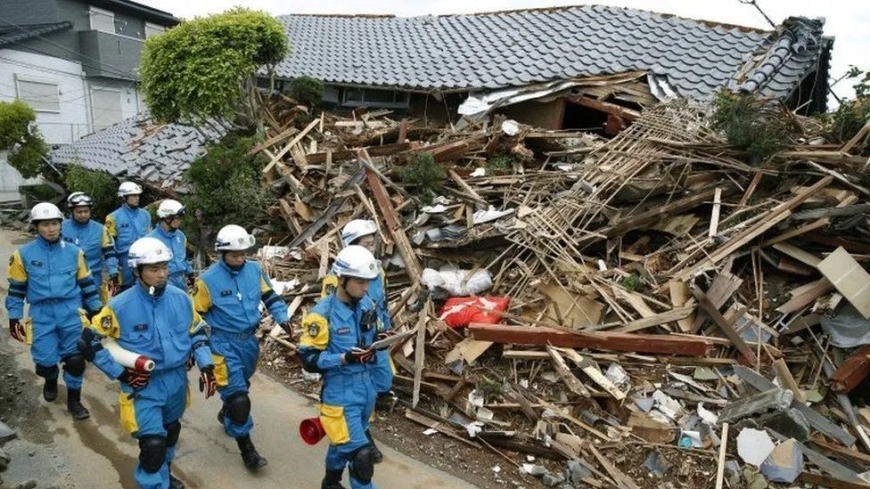
On Monday afternoon, a powerful 7.5 magnitude earthquake struck western Japan, prompting a tsunami alert and urgent evacuation warnings for residents in affected coastal areas.


The earthquake occurred at 4:10 p.m. local time, reaching a depth of 10 kilometers (6 miles) approximately 42 kilometers (26 miles) northeast of Anamizu in Ishikawa prefecture, as reported by the United States Geological Survey (USGS).
Following the seismic activity, the Japan Meteorological Agency swiftly issued a tsunami warning along the coastal regions of western Japan. Within just over 10 minutes, the first waves were reported hitting the coast. Initial reports from the city of Wajima in Ishikawa prefecture noted tsunami waves of around 1.2 meters (3.9 feet) at 4:21 p.m., according to Japanese public broadcaster NHK, with no immediate damage reported.
However, a major tsunami warning persisted in the city of Noto in Ishikawa prefecture, anticipating waves of approximately 5 meters, as confirmed by the Japan Meteorological Agency.
In a televised address, Japan’s Chief Cabinet Secretary Yoshimasa Hayashi urged residents in areas under tsunami warnings to evacuate promptly to higher ground. NHK footage captured the intense shaking of cameras and the impact of waves hitting the coastline in Ishikawa prefecture, revealing collapsed roofs and shaken foundations of houses.
Social media videos depicted aftermath scenes with store aisles scattered with goods. Additionally, footage from inside a train showcased platform signs rocking intensely with the tremors.
The earthquake left more than 32,500 homes in Ishikawa prefecture without power, according to Hokuriku Electric Power. Japan’s Kansai Electric reported no abnormalities at nearby nuclear plants.
A series of strong aftershocks followed the main quake, including a 6.2 magnitude aftershock at a depth of 10 kilometers (6 miles) southwest of Anamizu and other tremors measuring 5.2 and 5.6 magnitudes in nearby areas.
Prime Minister Fumio Kishida assured the public of timely and accurate information dissemination from the government.
Reports indicated waves of less than a meter in various areas along Japan’s western coast, categorized under “tsunami advisory.” The South Korean Meteorological Administration monitored potential sea level changes in specific regions, and a tsunami threat was declared in eastern Russian cities facing the Sea of Japan, including Vladivostok, Nakhodka, and Sakhalin.