



























The latest Webb picture of Uranus displays its enigmatic traits
The James Webb Space Telescope has snapped a glowing new portrait of Uranus that showcases the ice giant’s typically hidden rings

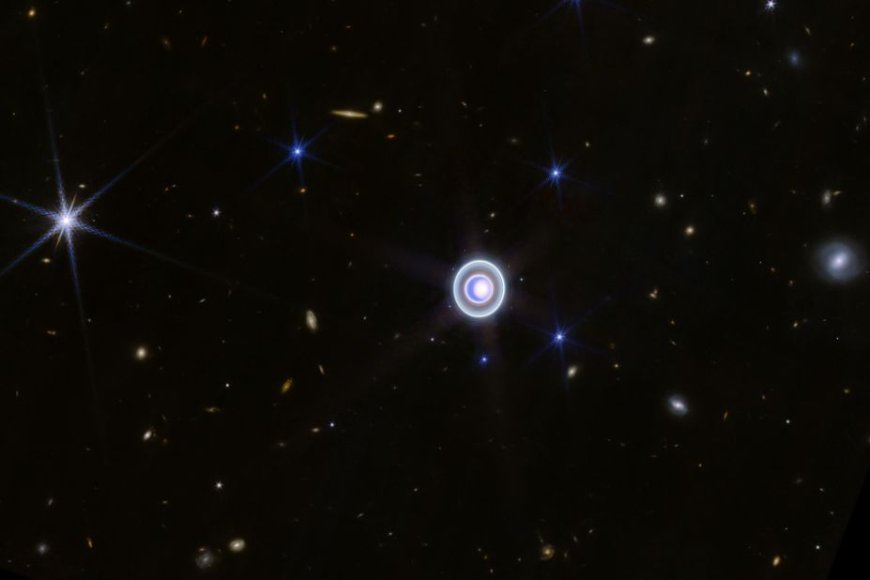
The James Webb Space Telescope has captured a new and vivid portrait of Uranus, revealing details such as its hidden rings, moons, weather patterns, and atmosphere. This image, in contrast to the first close-up of Uranus over three decades ago by Voyager 2, offers a comprehensive view of the ice giant's dynamic nature.
Unlike visible light observations, the Webb telescope, using infrared light, showcases features often overlooked in other telescope images. The latest image displays Uranus' typically faint inner and outer rings, including the dim and diffuse Zeta ring. Additionally, nine of Uranus' 27 known moons are visible as blue dots, including those within the rings, named after Shakespearean characters.
The image highlights Uranus' seasonal white north polar cap, taking center stage as the planet's tilt points toward the sun during its approach to solstice, expected in 2028. Uranus, with its unusual 98-degree tilt, experiences extreme seasons due to its spinning on its side. A Uranian year lasts about 84 Earth years, with half of the planet experiencing a dark winter lasting 21 Earth years.
The image reveals storms near and beneath the polar cap in Uranus' atmosphere. Scientists are keen to study how the polar cap and the planet's weather change as it approaches solstice, offering insights into Uranus' complex atmosphere. Despite the lengthy Uranian year, which lasts decades from Earth's perspective, a day on Uranus passes quickly, taking about 17 hours. The Webb telescope's ability to capture both long and short exposures has provided astronomers with unprecedented details of Uranus' features, challenging to observe due to its rapid spin.