
























Large industrial robots are being built by PaintJet for large industrial paint tasks.
The next big area of robotics investment may turn out to be construction. Approximately eight million people are employed by the $2 trillion sector in the United States.

In the ever-evolving tapestry of technological innovation, the construction industry emerges as the next canvas for the brushstrokes of robotics investment. Picture the vast expanse of a $2 trillion realm, employing a workforce akin to a bustling city, where nearly eight million individuals weave the fabric of infrastructure. Yet, even in the throes of financial prosperity, the challenges of this domain are laid bare — the demanding physicality, the looming specter of hazards, and the perpetual struggle to fill the ranks.


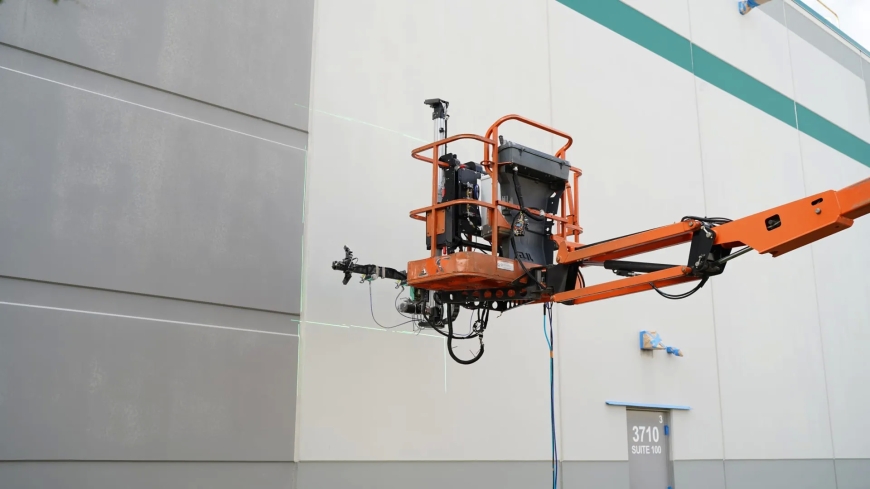
Enter the realm of industrial painting, an arena ripe for the transformative touch of automation. Within the great American landscape, where structures ascend to the heavens, a startup named PaintJet envisions a future where robots dance upon scaffolds, their metallic arms painting the skies with precision and grace. In the heart of Nashville, a city that hums with the melodies of innovation, the Bravo robotic painter unfurls its wings. It stands as a testament to the marriage of age-old heavy machinery and cutting-edge automation — a mobile elevated work platform, a robotic cherry picker ready to ascend the heights of industrial prowess.
Nick Hegeman, the visionary orchestrator behind PaintJet, unveils the symphony of innovation. "We have created 100% of the robotic system," he declares, his words resonating like chords of progress. "The parts that are from industry suppliers are the paint hoses, nozzles, and pumps." It's not just machinery; it's an amalgamation of artistry and technology, a seamless connection to the platform that elevates and controls, fostering a balletic harmony with the vast network of equipment rental providers.
In the October air, PaintJet announced its $10 million Series A, a crescendo led by Outsiders Fund, with a supporting ensemble featuring Pathbreaker Ventures, MetaProp, Builders VC, 53 Stations, and VSC Ventures. This follows a $3.5 million seed, an earlier overture conducted by Dynamo Ventures, bringing the startup's funding opus to a resounding $14.75 million.
As the curtain rises on this funding symphony, Nick Hegeman takes center stage, addressing the ongoing staffing conundrums. "It’s not just about automation; it’s about redefining industry standards, addressing labor shortages, and introducing cost-effective solutions that break the mold of traditional painting," he declares, casting a spell with his words. The investors, a discerning audience, nod in harmony, backing the mission to expand geographically and venture into new sectors.
Alongside the Bravo's debut, PaintJet unfurls another stroke of brilliance — Alpha Shield paint, a technological masterpiece claiming to defy the elements, extending the lifespan of painted surfaces. The stage is set for a revolution not just in machinery but in the very essence of industrial longevity.
Yet, PaintJet is not a lone virtuoso in this symphony of automation. Competitors like Gray Matter wield painting arms across different scales, while the colossal Japanese robotic arm giant, Fanuc, graces the stage with its solutions, albeit confined to lower heights. PaintJet, with Bravo as its virtuoso, reaches new heights — quite literally, as it tackles structures that pierce the clouds.
As the applause echoes through the industry halls, PaintJet continues to target construction companies as its primary audience. Prologis, Clayco, Layton Construction, and Brinkmann Constructors find themselves in the elite clientele, witnesses to a technological ballet that promises to redefine the canvas of industrial painting.
In the realm of creativity, PaintJet's headcount, a modest ensemble of 24 full-time employees, orchestrates a narrative of innovation. The new funding serves as the conductor's baton, guiding the expansion of sales and operations. The journey, however, involves a change of scenery, a shift of headquarters from the harmonious vibes of Nashville to the shores of Virginia. Here, the company envisions a foray into the marine business, a journey into uncharted waters, and a bolstering of engineering prowess to amplify the resonance of their technological symphony for wider distribution.
And so, in the grand theater of innovation, PaintJet's Bravo continues to dance upon scaffolds, a robotic painter poised to paint the future with hues of automation, resilience, and visionary strokes that transcend the confines of traditional norms. The world watches, enraptured, as the construction industry becomes a canvas upon which the brushstrokes of progress redefine the very essence of industrial artistry.