







Ahead of Ramadan, Algeria opens the third-largest mosque in the world.
Algeria unveils Djamaa El-Djazair, Africa's largest mosque, marking a significant architectural feat amidst controversies. Explore the grandeur and controversies surrounding the long-awaited inauguration ahead of Ramadan

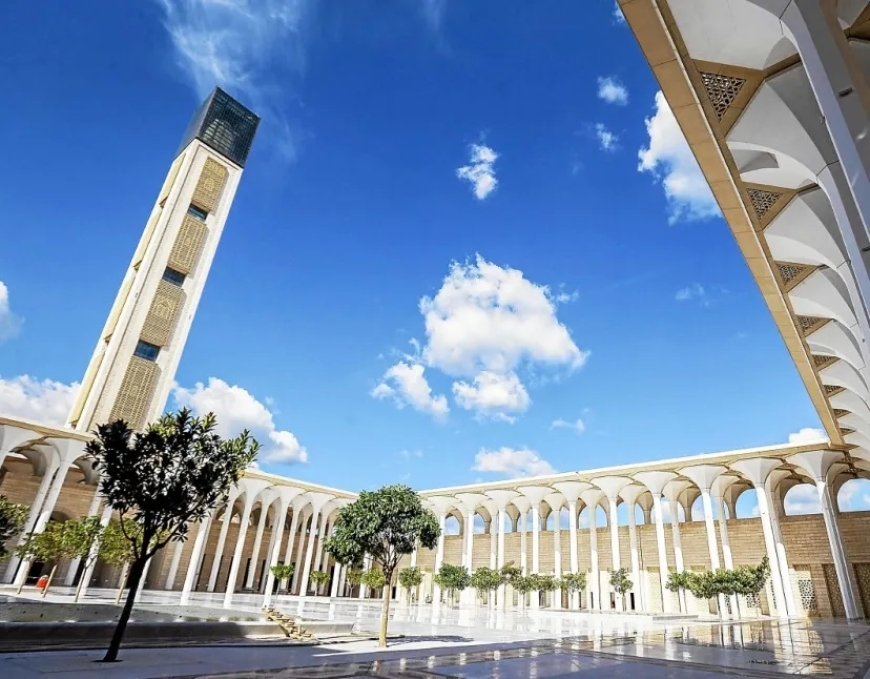
Algeria Unveils Africa's Largest Mosque Ahead of Ramadan


Algeria recently celebrated the inauguration of the Grand Mosque of Algiers, marking it as the largest in Africa and the third-largest globally. The long-awaited event, delayed by political shifts and controversies, finally took place under the auspices of President Abdelmadjid Tebboune.
Officially named Djamaa El-Djazair locally, the mosque stands as a modernist marvel sprawled across 27.75 hectares along the Mediterranean coastline. Its towering minaret, standing at 265 meters (869 feet), is the world's tallest, while its capacity to accommodate 120,000 worshippers makes it second only to Islam's holiest sites in Mecca and Medina.
Constructed over seven years, the mosque boasts intricate decorations of wood and marble, adorned with Arab and North African motifs. Notably, it features amenities such as a helicopter landing pad and a library capable of housing a million books.
Despite its recent inauguration, the mosque has been accessible to international visitors for five years and opened for prayers in October 2020, albeit without Tebboune, who was battling COVID-19 at the time.
However, the project, which reportedly cost close to $900 million and was executed by a Chinese firm, has faced criticism for its delays, cost overruns, and alleged construction in a seismically hazardous area—a claim the government vehemently denies.
Critics have also viewed the mosque as a symbol of former President Abdelaziz Bouteflika's regime, suggesting it was a vanity project reflecting his 20-year tenure, which ended amid widespread protests and military intervention in 2019. Despite his intentions to inaugurate it, Bouteflika never saw the completion of the mosque named after himself.