












Vladimir Putin has declared his intention to compete for president once more in the 2024 election

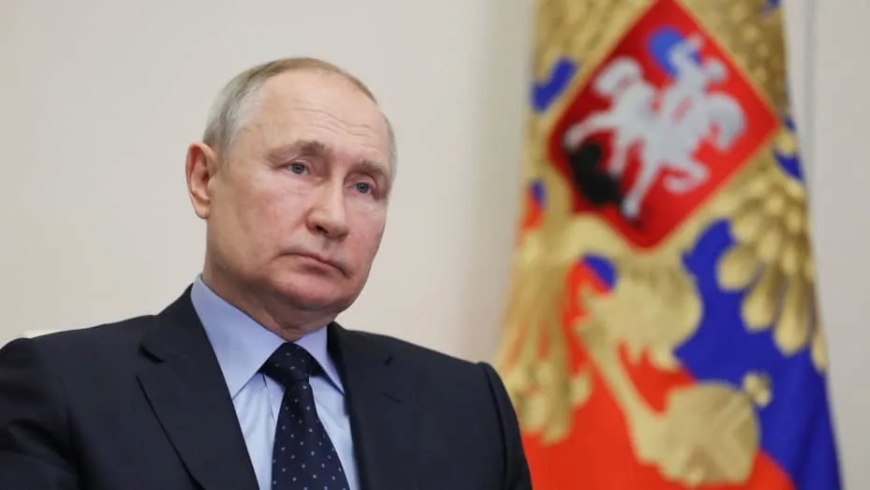
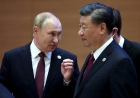
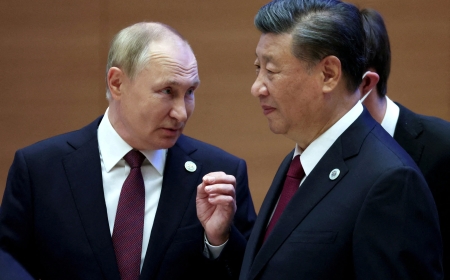
Vladimir Putin has declared that he would seek the presidency once more in the March 2024 elections in Russia, a decision that may see him hold onto power until at least 2030. Following a ceremony at the Kremlin, the Russian president's official home, Putin announced on Friday.


In an attempt to maintain his hold on power as prime minister or head of state for more than 20 years, Putin will run for president a fifth time in the elections scheduled for March 17, 2024. Residents in the seized Ukrainian regions of Donetsk, Luhansk, Zaporizhzhia, and Kherson—annexed by Russia during the conflict—will also be voting in their first presidential election in the 2018 elections. The Central Election Commission of Russia said that on March 15, 16, and 17, over the course of three days, "house-to-house voting" will be held in those four areas. The local elections in these places, which were arranged by officials with Russian support, were already denounced by the international community as fraudulent.
August 1999 saw Putin take over as Russia's acting prime minister, and on New Year's Eve of that year, then-President Boris Yeltsin abruptly gave Putin the president. Before leaving office in 2008, he held the office for two four-year terms. This was because he was not allowed by the Constitution to seek another term as president. He supported Dmitry Medvedev, who succeeded him as president, and Putin became prime minister once more.
However, he won back the presidency in 2012, and he hasn't let go of it since. Putin first signed a bill in 2021 that allowed him to seek two more six-year terms after winning reelection in 2018.
Due to the legal modifications, Putin, 71, may be able to continue ruling until 2036, when he will be well into his third decade of power and in his mid-80s. In March, Putin should only see minimal resistance. Opposition politicians have suffered similar outcomes during his autocratic rule: exile, incarceration, or death under dubious circumstances.
On allegations of extremism, Russian opposition leader Alexey Navalny, who presented one of Putin's biggest political obstacles while he was in office, was given a 19-year jail term in August. According to Navalny and his allies, his detention was politically motivated and meant to stifle his criticism of Putin. When Navalny returned to Russia in 2021, he was taken into custody right away. 2020 saw him transported from Russia to Germany following his poisoning with the nerve toxin Novichok, which was used during the Soviet period. After being sent to a hospital in Berlin for medical attention from the Siberian city of Omsk, Navalny was found unconscious. Following a collaborative investigation by Bellingcat and CNN, the Russian Security Service (FSB) was found to have been involved in Navalny's poisoning. Russia disputes any role in the poisoning of Navalny. Putin declared in December 2020 that Russian security services "would have finished" the assassination of Navalny if they had desired to do so.
When March rolls around for presidential elections, Putin's conflict in Ukraine—which Russia had first predicted to last only a few weeks—will have probably reached its second year. Despite the costs to Russian society, the conflict is still widely supported by the population, despite the difficulty in correctly assessing public opinion in the country. The Kremlin makes an effort to shield the Russian people from the worst of the fighting, but Ukraine has made several attempts to bring the battle closer to home by conducting its strikes on Russian towns, including the Kremlin.
The exact number of Russian casualties from its conflict in Ukraine is still unknown. Defense Minister Sergei Shoigu declared in September 2022 that 5,937 soldiers had lost their lives in the conflict. Since then, the ministry has not released a report.